Unknown's avatar

A Short Reflection on MLK

Some days I don’t leave my house because I speculate other people will annoy me.

I get into moods where I’m frustrated at others’ lack of depth, immaturity, selfishness, or condescension. Today was one of those days.

I recently finished a collection of speeches by Martin Luther King, Jr. Perhaps the hardest to read was his eulogy at the funeral for three of the children killed at the Sixteenth Street Baptist Church bombing.

I found his words remarkable, especially when he started talking about Southern whites:

And so I stand here to say this afternoon to all assembled here, that in spite of the darkness of this hour, we must not despair. We must not become bitter, nor must we harbor the desire to retaliate with violence. No, we must not lose faith in our white brothers. Somehow we must believe that the most misguided among them can learn to respect the dignity and the worth of all human personality.

I’ve spent four years learning how to be critical, learning how to recognize bad arguments, bad behavior, and bad living. I’ve spent four years placing people into convenient categories. I’ve spent four years defining myself as “not other people.”

King called that community to love, though. He told them not to lose faith in the enemy.

I don’t have an enemy. I create enemies for the drama.  So how much easier should it be for me to have faith in the people who annoy me?

Picture found here.

Unknown's avatar

Why Not?

I.
“Why?” she asks.

Her name is Emily. I met her five minutes ago. Her first question was “Do you like to dance or do you love to dance?” That turned into “Do you love to dance or are you in love with dance?” That turned into “If you are in love with dance, would you marry it?”

Now we are talking about my future. I tell her I’m going to be a teacher. And now we are here.

“Why?” she asks.

I mumble something about TFA offering me a placement. She seems content with this. Our conversation continues. When it threatens to die:

“Why?” she asks.

I appreciate what she’s doing. It makes a more interesting conversation than the typical party fare.

II.
In three months, I will graduate from college (Lord willing that I finish my thesis first). I enter the shortest commitment I’ve ever made with my time. Two years teaching. Many of my peers will have shorter commitments than that if at all. It’s weird.

I want to plan the rest of my life right now. I want to lay down a plan. I want to have an end goal and I want to plot the path that will lead me there. I want to figure out exactly who I am. Who is the “real” Spencer? What does he like? What does he do?

III.
In high school, I had a girlfriend, I played golf, and I was a practicing Christian. These things took up most parts of my identity. But I also did stupid stuff. I spent too much time on the computer, too much time watching television, too much time playing video games, too much time thinking life was hard.

When I went to Bible studies, though, we would talk about giving our lives over to God. But we hardly ever talked about television, video games, or the computer. Instead, the leader would turn to me and say “Spencer, what if God made you give up your girlfriend or golf?”

The conversation has evolved since then. No one puts it into quite those terms. We still talk primarily about the same thing, though. When we talk about wisdom, for instance, we correctly note the difference between wisdom and academic knowledge, but then we draw the wrong-headed conclusion that some academic knowledge, because it is not wisdom, is useless.

IV.
I want my life to have meaning. I try to achieve that through faith. If there are bigger ideas tugging at my soul like justice and peace and love, then it is easier to forget about the things that don’t matter. The problem is that, as a human, I must slog through the “thing that don’t matter.” I cannot instantly achieve justice, peace, or love. I must work at these things. I must chip away at the stones in my eyes that keep me from seeing them.

But what I hate about my faith is that it falls prey to the same things that the world falls prey to–namely, prescribed narratives. There are things in the Church that we assign importance to with no real explanation–mission trips, having a family, leading a ministry. We put up with the minutiae of our day-jobs and educations in order to be a part of these things. But these things, in and of themselves are not meaningful. Mission trips can sometimes do more harm than good. Families fail when members think their purpose on this earth is that family. The Westboro Baptist Church is a ministry. We lose justice, peace, and love for the American Dream. Or for the Christian sell-everything-you-have-and-walk-barefoot-around-the-world Dream.

V.
I believe that God has an intimate relationship with me. I believe He is talking to me even when I’m not listening. And it is for this belief, that sometimes, I gain enough courage to trust.

VI.
Emily walks away. I’m glad. She is fun, but the question “why” is beginning to become annoying.

I begin to walk around the party more freely, not afraid to talk to groups of people I only marginally know. When the iPod stops playing, I know that I want to turn on music that I want to listen to. Informed by both my own tastes and those of the people at the party, I turn on Aaron’s Party.

Emily, who has left the room by now, comes back to dance. This time she does not ask why.

Unknown's avatar

The Trouble with Gaps

There was a moment this summer, while I was teaching a room full of high-achieving, and in my mind, at-risk students, where I faltered. I don’t remember the lesson or what made me privately freak out in my mind, but I remember the feeling… the American dream is a lie, “at-risk” is a stupid term, students are students are students, and teaching students so they can live up to a white, wealthy ideal is pointless.

But I didn’t let the feeling take hold of me. I pushed it away. It got lost in the stress of lesson plans and grading papers.

Several weeks later I returned to Ohio University, where my main extracurricular commitment revolved around education reform, a nebulous term that means many things to many different people. And because I am someone who enjoys a good discussion, I made sure I was immersed in the literature of people who are critical of the reform movement.

It is within this literature, that I first read Dr. Camika Royal’s argument against the use of the term “achievement gap.” A term I had used countless times myself, achievement gap had become, for me and many of my peers, a shorthand way of articulating the problem we saw in education. Upon my first reading of Dr. Royal’s piece, I thought this was the problem with the term–that achievement gap did not accurately portray the complexity of the problem.

And organizations I am a part of changed; instead of using achievement gap, both Students for Education Reform and Teach for America have adopted “opportunity gap” as part of their lexicons. Dr. Royal suggested the term in her first piece about the achievement gap on Good.

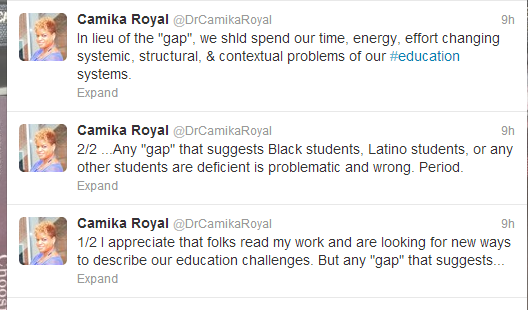
Several days ago, however, Dr. Royal began suggesting that this simple substitution of the terms is insufficient.

Image

At first, I was taken aback by this. It seemed like organizations were listening to Dr. Royal. Why was she still frustrated?

And then I thought about her piece, again. This time, though, I thought about my summer experience, specifically the feeling I had had one day in class and ignored, and then some things clicked.

Dr. Royal is not frustrated about the term with a linguistic concern. She is frustrated with the power struggle that gets buried in language.

I asked my friend the other day how I can avoid a white savior complex. And he told me I had already fallen prey to it just by believing there was a group of people, categorically different than me, who needed my help. By dividing the world into white and black, I had already named difference, and by naming difference, I had already committed oppression.

This, I think, is what we do when we talk about gaps. Because when we acknowledge a gap, we set up a situation where things are better. And it’s not necessarily racial. Like we assume that wealth is better than poverty, that a Princeton degree is better than a GED, or that scoring in the 99th percentile is better than scoring in the 61st.

But here’s the rub. Oppressors have always chosen the grading stick. Oppressors have always been the ones who get to decide what we test, how we test it, and what background knowledge we test. Oppressors have always been the ones who decide what is better. And that is the issue.

If we ignore this problem, we risk, at the very least, pretension–the kind that claims you are not allowed to talk about a problem because you aren’t well-informed enough.

I don’t know how to do it. I don’t know how to talk abut the issues we need to talk about. But I know that lumping entire of populations of students into one “at-risk” category is trouble. And that’s exactly what gaps do.