Unknown's avatar

Beliefs Without Consequences

I’m currently reading Grace Lee Boggs’s autobiography Living for Change. Grace Lee Boggs is an activist in Detroit. She and her husband Jimmy Boggs were important organizers in the 1960s during the unrest in Detroit caused by the Civil Rights Movement and Ms. Boggs stays active today.

In her autobiography, she has an entire chapter on her husband. The chapter is an amazing look at how a political-minded person with a heart for love can create real change. She writes:

…Jimmy was always taking care of others. If he looked out the window and saw someone trying to start his car, he was out there like a flash offering his help. He filled out income tax forms for people in the community and for his coworkers, white and black. They trusted him more than they trusted H&R Block and brought their friends and relatives to him. I especially recall Mike, an old Italian retiree with a throat ailment that made him barely audible. Playing the numbers was Mike’s only recreation. One year, after Jimmy had done his taxes, Mike concluded that Jimmy had the inside dope on which number would come out each day. Jimmy didn’t want to disillusion Mike because having someone to talk to every day obviously meant so much to him. So every evening until Mike died, he would call and they would go through the ritual of Jimmy telling him what number had come out that day and giving him a number to play tomorrow.

Jimmy was especially caring toward young people and elders. We watched three generations of young people grow up on Field Street, where we lived for more than thirty years. He called them “my girls” and “my boys,” kept track of how they were doing in school, and was always ready to help them with their homework or with advice about a summer job or how to get a student loan.

Today, I was registered to take the English certification exam in Michigan so that I would be able to teach English there. But I slept through the exam. I slept through the exam.

I was making plans to go out tonight when the Zimmerman verdict came in.

And it’s just… what am I doing? What am I doing that it’s okay that I slept through an exam? What am I doing that it’s okay that I spend my weekends trying not to think about anyone but myself?

TFA really pushes us to create a sense of urgency in the classroom. If my students feel that every lesson I teach is the most important thing they have ever learned, then they will be hooked. That’s the goal. And I guess I’m coming to the realization that my life lacks any sense of urgency. I slept through an exam this morning. Who does that? If I really believe that the world needs changing, then what am I doing about it?

Grace Lee Boggs writes elsewhere:

I never ceased to envy and marvel at the fluency with which Jimmy wrote and the speed with which his pen would travel from the left side of the page to the right. When he came home from work, he would lie down on his stomach on the living room floor with a yellow pad and start writing. He would wake up mornings and dash off letters to the editor before breakfast.

That’s the kind of urgency I want. I’m tired of beliefs without consequences.
Unknown's avatar

The Trouble with Gaps

There was a moment this summer, while I was teaching a room full of high-achieving, and in my mind, at-risk students, where I faltered. I don’t remember the lesson or what made me privately freak out in my mind, but I remember the feeling… the American dream is a lie, “at-risk” is a stupid term, students are students are students, and teaching students so they can live up to a white, wealthy ideal is pointless.

But I didn’t let the feeling take hold of me. I pushed it away. It got lost in the stress of lesson plans and grading papers.

Several weeks later I returned to Ohio University, where my main extracurricular commitment revolved around education reform, a nebulous term that means many things to many different people. And because I am someone who enjoys a good discussion, I made sure I was immersed in the literature of people who are critical of the reform movement.

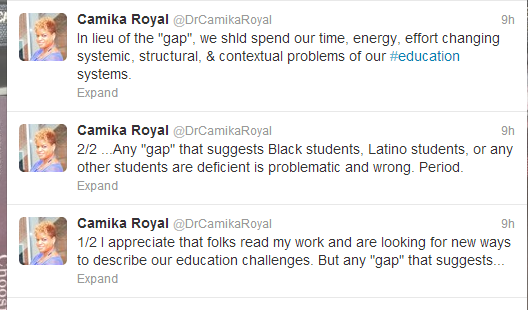
It is within this literature, that I first read Dr. Camika Royal’s argument against the use of the term “achievement gap.” A term I had used countless times myself, achievement gap had become, for me and many of my peers, a shorthand way of articulating the problem we saw in education. Upon my first reading of Dr. Royal’s piece, I thought this was the problem with the term–that achievement gap did not accurately portray the complexity of the problem.

And organizations I am a part of changed; instead of using achievement gap, both Students for Education Reform and Teach for America have adopted “opportunity gap” as part of their lexicons. Dr. Royal suggested the term in her first piece about the achievement gap on Good.

Several days ago, however, Dr. Royal began suggesting that this simple substitution of the terms is insufficient.

Image

At first, I was taken aback by this. It seemed like organizations were listening to Dr. Royal. Why was she still frustrated?

And then I thought about her piece, again. This time, though, I thought about my summer experience, specifically the feeling I had had one day in class and ignored, and then some things clicked.

Dr. Royal is not frustrated about the term with a linguistic concern. She is frustrated with the power struggle that gets buried in language.

I asked my friend the other day how I can avoid a white savior complex. And he told me I had already fallen prey to it just by believing there was a group of people, categorically different than me, who needed my help. By dividing the world into white and black, I had already named difference, and by naming difference, I had already committed oppression.

This, I think, is what we do when we talk about gaps. Because when we acknowledge a gap, we set up a situation where things are better. And it’s not necessarily racial. Like we assume that wealth is better than poverty, that a Princeton degree is better than a GED, or that scoring in the 99th percentile is better than scoring in the 61st.

But here’s the rub. Oppressors have always chosen the grading stick. Oppressors have always been the ones who get to decide what we test, how we test it, and what background knowledge we test. Oppressors have always been the ones who decide what is better. And that is the issue.

If we ignore this problem, we risk, at the very least, pretension–the kind that claims you are not allowed to talk about a problem because you aren’t well-informed enough.

I don’t know how to do it. I don’t know how to talk abut the issues we need to talk about. But I know that lumping entire of populations of students into one “at-risk” category is trouble. And that’s exactly what gaps do.

Unknown's avatar

Why I SFER

Recently, there has been a lot of alarm about an organization I am a part of – Students for Education Reform. I think this alarm mostly started with this post by a really smart girl from Rutgers named Stephanie Rivera. Diane Ravitch, a prominent player in the education reform conversation, then got hold of  Rivera’s post, and applauded her and took a stance against SFER. And next thing I knew, my Twitter feed was blowing up. I have been thinking about this the past week or so, and I think it would be helpful to explain why I, a student, started a chapter of Students for Education Reform at Ohio University. This is going to be a long post so I thank you in advance for your patience.

My name is Spencer Smith. And I SFER because I think that every child deserves a great education right now.

I went to school K-12 in Springboro, OH. Springboro is the ninth richest school district in Ohio. Our graduation rate is over 97%. Of those 97%, most go on to college. I tell you this knowing full well that if critics want to throw the privileged spear at me, they can do it now. But better I come out and say it then someone think they are digging up the information. 

I didn’t get into my top choice universities. I landed at a great honors program at the very public Ohio University. OU is routinely ranked as the number one party school in America. When I would tell my high school friends where I was going, they would wrinkle their noses. But really, OU is a relatively good school. It holds its own against the much bigger Ohio State University and the slightly more prestigious (maybe) Miami University. The middle fifty percent of admitted freshman are a good bunch. They are good students. Not great students. But good students. Probably B students, most of them. Additionally, because of its location in Appalachia and its middle-of-the-line tuition, it’s home to many first generation college students.

For my first two years at Ohio University, I didn’t think much about education. I had made it to college. I figured that everyone who wanted to be at college was there. It was a done deal for me. I grew a beard, and started thinking about things like racism, sexism, and heteronormativity the way only a white straight dude from the ‘burbs can – theoretically. Then, at the end of my sophomore year, Teach for America invited me to be part of a series of leadership seminars. I heard about the achievement gap for the first time. My world was rocked. There were places where only 8% of students graduated from college? This was huge news for a kid coming from a place where it seemed like 80% of students were going to graduate from college. (This is probably an exaggeration, but that’s what it felt like).

I stayed in contact with Teach for America. I participated in a summer book club. One night, I was on a call discussing Mike Johnston‘s In The Deep Heart’s Core. Mike Johnston was on the call and he offhandedly mentioned Students for Education Reform. I sent an e-mail to Alexis Morin that night. Because she was listed as a co-founder on the website, I didn’t expect to hear back from her. But I heard back almost immediately. That summer I learned a lot about the organization. I learned how it started in a dorm room with e-mail blasts between the early members. I learned how it was infectious. And certainly, Alexis’s and Catharine Bellinger‘s enthusiasm and optimism is infectious. They come from a tradition of thought that says when you believe something, you do something. You don’t sit on the sidelines. You get up and say something. I wanted to do something, too.

So I did. And for the past year I’ve been the Chapter Leader at Ohio University. In that year, my knowledge of the education crisis in this country has grown more nuanced. I used to think that there was someone to blame for the whole thing. And that wasn’t anything SFER taught me. That was just me being a dumb college student. Thanks to SFER and other opportunities, I had the chance to study ed policy more in depth. Through Chapter Leader training and the weekly discussion series our chapter held on campus, I was able to approach issues from multiple angles. A lot of the members of our chapter are future teachers. (I’m a future teacher, too!) We aren’t calling for the abolition of teacher unions or the privatization of education. What we are calling for is conversation. We want to put everything on the table. We want options.

Because of SFER, I have done and seen things that I would have otherwise never done or seen. I organized a school visit to KIPP Journey in Columbus. I learned that whether or not you agree with charter schools, there are kids who are benefiting from them. And those kids can articulate that. They know that they are going to college. And they know that precisely because of the school they are going to. I was so impressed that I interned with them for a while.

SFER hosted a national summit for all the chapter leaders. By the time the summit rolled around, there were almost 100 chapters. I was struck by our diversity. Sure, I was a dude from the ‘burbs. And sure, there were Ivy League schools represented. But there were also chapter leaders who were mini-miracle stories. They had beat the odds in low-performing school districts, made it to college, and were now working to make sure that more students had that same opportunity.

Additionally, because of the SFER national summit, I learned about the Breakthrough Collaborative. I applied to Breakthrough, got accepted, and spent my summer teaching ninth grade English. I learned that 30 high school and college students can alleviate summer drain for over 100 middle schoolers.

Because of SFER, I believe that education reform is not just a conservative thing, a liberal thing, a union thing, a student thing, a teacher thing, a parent thing. Education reform is all of those things. We aren’t going to get anywhere by eliminating each other from the conversation. Maybe you don’t agree with SFER or Teach for America or Democrats for Education Reform. That’s fine. You don’t have to. But don’t be against them. Be against the achievement gap. Be against the failing education system. I promise you we can work together.