Unknown's avatar

What We Talk About When We Talk About Rob Bell

Last week, controversial Christian thinker Rob Bell released his new book, What We Talk About When We Talk About God. Remarkably tame compared to his best-selling Love Wins, the book is perhaps less interesting than Bell himself. Bell has been in headlines recently more for his affirmative support for same-sex marriage than the release of his book. Nevertheless, the book represents an important idea. It is an articulation of the emergent church to both the wider Christian community and the general public. In Christian circles, the emergent church has been struggling against more fundamentalist and evangelical communities for popularity, but this struggle has been one mostly limited to theologians and church leaders. WWTAWWTAG will probably be the first book many people read with emergent church ideas.

Like most of Bell’s writing, WWTAWWTAG is more question-asking than question-answering. The content is never dense, which is generally good, but sometimes Bell fails to make the connections that would link his ideas together. He relies on a structure throughout the book where he tells a story and then jumps into the idea he wants to articulate. Often, though, it is not entirely clear how the story is related to the idea. And sometimes, it feels like we could learn more from his stories and personal experiences than we can from his existential graspings. For instance, he tells about an Easter Sunday when he was doubting the existence of God but had to deliver an Easter service to thousands of people, and he ends talking about that experience by saying:

That Easter was fairly traumatic, to say the least, because I realized that without some serious reflection and study and wise counsel I couldn’t keep going without losing something vital to my sanity. The only way forward was to plunge headfirst into my doubts and swim all the way to the bottom and find out just how deep that pool went. And if I had to, in the end, walk away in good conscience, then so be it. At least I’d have my integrity.

The metaphor is beautiful, but I want to know what he did. How does a pastor who hardly believes in God deliver an Easter sermon? That’s interesting.

Despite these sorts of shortcomings, the book manages to land on some really important ideas. For instance, Bell is convinced that God is constantly drawing people forward. He confronts the idea that Christianity is backwards-looking, trying to achieve a forgotten Golden Age. Troubling passages from Exodus or Deuteronomy, he says, should not be read as a tribal, ruthless God speaking to ruthless tribes. Instead, the immeasurably awesome God is providing these tribes things they can actually do that are just a little bit more just and more orderly than what other tribes do. So Bell makes us consider historical context, but then he also challenges us to consider that we are not as different from the tribe of Israel as we might think. It is here where Bell is at his finest–when he is applying concepts like context and historical criticism and subjectivity to transcend and actually make our view of God bigger rather than smaller.

The first major argument in the book is that God meets us where we are and then pulls us into the next stage of godliness. God is always a little bit ahead of us, reaching out his hands to carry us to the next place. 

Bell, then, makes faith scary again. Because if God is always a little ahead of us, it’s a little hard to think about how we should think about modern issues–like same-sex marriage, for instance. Same-sex marriage is never explicitly mentioned in the Bible, of course. Same-sex sexual relationships are condemned, even in the New Testament. But same-sex marriage is generally seen as a progressive, forward-thinking issue. And if it’s forward-thinking and God is always ahead of us, then He must be there also. But then is faith contingent on popular opinion? Are we supposed to believe Bell just because he says he is forward-thinking? Can we imagine a Christian leader who seems genuinely committed to progressivism but is against same-sex marriage or other progressive issues that are generally seen as in conflict with Christianity?

The second major argument in the book is that there is no distinction between the holy and the unholy or the sacred and the base.

And that the story of Christianity is about drawing us into understanding how everything is sacred. When Bell talks about this idea, it’s beautiful. And convincing. But it raises many questions. Like, is sin sacred? But there is this sense that if we were able to recognize everything that God has a hand in as sacred–our bodies, other people’s bodies, our minds, other people’s minds, the earth, resources, children, the elderly, married people, single people, Christians, non-Christians, priests, laymen, animals, and outer space–it would be next to impossible to sin.

I don’t think Bell is done with the world. I expect he will continue to be an important leader and will continue to turn people towards Christ. But I also think things are going to get worse in the Church before they get better. The more we hurl the insult of heretic on Bell, the more divisive things become and the more the Church backs itself into a corner.

Postmodernism tells us that everyone, in a certain sense, constructs God in his/her image. So Bell might be creating an overly-liberal God. But then what does that say about conservative Christianity?
Unknown's avatar

Being Silent

I’ve been following the backlash from the media coverage of the Steubenville rape case pretty closely. I’ve read all the important articles and blog posts. I’ve read all of my friends’ statuses and comments. I’ve seen my friends’ anger, their commitment to rationalism, and their frustration with patriarchal systems.

I’ve always struggled with what I should be saying about things where I don’t resemble the victim. What should I say about male-on-female rape or sexism or racism? I like to talk about these issues but am I limited to parroting what female, minority, and/or LGBTQ friends and/or scholars say about them?

My friend, Tyler Borchers, pointed me to “Dismantling whiteness: Silent yielding and the potentiality of political suicide” by a professor here at Ohio University named Dr. Jungkunz.

Jungkunz writes:

To reiterate, part of what privilege has involved in garrulous contemporary settings has been a monopoly over speaking. We have witnessed this surrounding sex, sexuality, race, class and gender. Masculine, white, ‘heterosexual’, wealthy men are privileged speakers. So, to engage insubordinate silence along any of these components of intersectionality is to engage several transformative contestations and participations. First, silence can demonstrate a protest against racism. Such protests can entail: silence instead of an encouraging laughter as a response to a co-worker’s racially offensive joke, or an organized silent protest involving duct tape over one’s mouth to call attention to oppressive quiescence. These silences can cut off the air (speaking) that gives life (via racist stereotyping) to white supremacy. Block de Behar notes, ‘that only silence can offer a means of avoiding the automatism of language’ (1995, p. 4). Second, silence can act as a democratic yielding. This yielding is insubordinate as it challenges norms that try to dictate who should and should not speak – so, to remain silent as a way to allow the ‘other’ to speak is inherently resistant to a whiteness-speech configuration of power. This is a silence for empowerment and transformation. Finally, silence as a refusal can seek to end one political existence – whiteness – only to open up the possibility of an alternative to a racialized polity for the future. This silence as refusal can involve the following: not claiming a race on the census questionnaire, remaining silent when someone asks for racial identification over the phone or upon a personal ad and not engaging an entire array of racially offensive names, topics, movies, songs, discussions and so on. At an even deeper level, this silence can be an active refusal of aspects, characteristics – white personality traits if you will – that slowly but importantly begin to kill off one’s whiteness. For instance, the urge to speak up and out can be refused; the exuding of confidence can be refused; and even the lack of racial self-consciousness can be refused.

I am really bad about this. I am really bad about being okay with silence. In fact, I’ve found myself knee-deep in discussions about Steubenville the past couple of days. And every time I get frustrated with one of those discussions, I try to move to a discussion with someone who I know will agree with me. This, I think, is both incredibly prideful and incredibly damaging.

Too often, I start to believe that the only way to affect political action is through speech. Through action. But that’s not true. Often, the way I can be most subversive in my privilege is to yield my voice to oppressed groups. My voice is not unimportant or worthless. It’s just that there is nothing of value my voice can add to the debate. I am not a survivor. I know survivors, but I know them as friends. And I think they are far more qualified to talk about their experiences than I am. My role should be to encourage other non-survivors to listen. To listen. To be silent.

I think of all the times I’ve laughed at a rape joke in the presence of other people. That’s not alright. Or all the times I’ve agreed when someone calls a girl a “slut.” That’s not alright. Or all the times I’ve been part of a community that encourages people to make decisions about sexual partners while under the influence of alcohol. That’s not alright. Silence would have been better.

Silence is probably better now.

Note: When I typed “silence” into Google to try to find a picture, I most often found pictures of women being silent. Yikes. Then when I typed in “silence man,” I got photos of scantily clad men sneaking up on sleeping women. um wut.

Unknown's avatar

Unpopular Opinions: The Line Between Cute and Not

A couple nights ago, a novelty Twitter account appeared on the OU Twitter scene.

OU Crushes, an account where students anonymously submit 140-character posts about their crushes, was suspended today on charges of sexual harassment. It’s easy to see why. Many of the tweets included full names and many of them were graphic in nature.

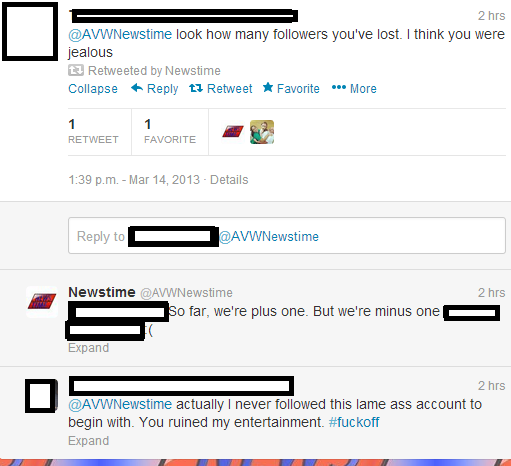
When some students took to Twitter to support the decision to suspend OU Crushes, they were quickly ridiculed and labeled wet blankets by fellow students.

AVW Newstime

When OU Crushes finally went back on line, they tweeted about their suspension, making sure to put sexual harassment in quotes. It’s not real sexual harassment, of course, their quotes said.

Folks, Imma admit it. At first, I was really into the idea of an OU Crushes. Mostly because I wanted to know who had a crush on me. And I think there is a world where OU Crushes is only cute, but we don’t live in that world.

There is a reason we want anonymity when we say things like “i would love to motorboat ____ but apparently she only goes for Jewish frat boy.” It’s because these things shouldn’t be said in the real world. Can you imagine a group of guys shouting that at a girl on the street? That would be sexual harassment. Anonymity and the Internet do not make it alright.

This is how rape culture is perpetuated. It’s perpetuated when we provide spaces that make it alright to publicly sexualize and objectify people. And then, when students speak up about it, they are labeled mean-spirited.

We need to stop thinking in this way–in this “don’t ruin the fun for everyone else way.” If one person is hurt by “fun,” then it shouldn’t be considered fun.