Unknown's avatar

Two Terms I Wish I Had Never Said

Over the years, I’ve created some terms. And I don’t say this to be conceited, or something. It’s just I like creating theories. And sometimes my theories need names. And every once in a while I discuss these named theories with my friends, and they like them, or whatever. Before I know it, people I don’t talk to are hashtagging my terms on Twitter.

If I’m being completely honest, then I need to tell you that I really like that terms I create catch on. It makes me very happy. And it makes me feel important. So I’m probably going to keep doing it.

But there are two terms I regret creating. I want to talk about those for a bit.

Super Ex. I think this theory was collaborative, but I can’t remember who helped me come up with it. I’m pretty sure I came up with the term. And if I didn’t, then I’m definitely the one who spread it around. So I’m taking responsibility for it.

The super ex is a shorthand way of talking about this theory I had for a while that everyone had one major past relationship by which they judge all following relationships. I formed this theory early on in college because all of the people I was befriending seemed to have had similar experiences: serious relationship in high school leads to serious breakup before college leads to serious hangup for all college relationships.

But the theory only made that cycle worse. By giving a name to it, I was normalizing it, saying it was okay to judge all of your relationships off of that one big one. I think that’s a really childish way to think about love, now.

There are a lot of people in this world. There are some people we like, some people we dislike, and some people we love. But every time we form a relationship with someone new, we form something completely new. We shouldn’t stand around comparing it to whatever came before. Apples to oranges, and all that.

Athens Attractive. I feel the worst about this one. This one is born out of my insecurities with the world. And that’s why I feel bad about it. At first, I thought it was funny. It could have been part of a comedy routine, for instance. And I think some people are still using it that way, which is nice. But some people, following my lead, are using it as a negative term. And that’s not okay. I want to take that back.

I created it because I was tired of all of the girls I was interested in going for the guys who are more free-spirited than I am. I’m a clean cut soul. I like pop music and I watch trashy television. I like to imagine that makes me into a regular Prince Charming. But it doesn’t and so I’m moving on and because I’m moving on, I’d rather not use Athens Attractive negatively anymore.

A friend of mine asked me if she was Athens Attractive the other day. And my mind immediately went down this checklist I had created for it. And then I realized that she didn’t want to be Athens Attractive because Athens Attractive in my head is negative, and she knew that. I’m a firm believer that no one should ever be called something they don’t want to be called. Everyone should have the opportunity to pick their own name. And that’s why Athens Attractive is wrong. It pigeonholes people.

So, if you all don’t mind too much, I am personally going to kill it.
Unknown's avatar

Righting Texts

When friends get in a relationship, one of my favorite things to say to them is that they are in a “honeymoon phase.” That lovey dovey feeling? Not going to last forever. Those feelings aren’t “real” love. And I am completely qualified to say things like that. It’s true.  Because single 21-year-old males are easily the most qualified to make claims like that.

I’m in this class on the psychology of narrative this quarter. And I was reading an essay by Michael White today about the analogies psychologists use to explain human relationships and stories. For a long time, beginning with Freud, the only analogies used by psychologists were that of science – either machines or organisms. These analogies do a lot of things correctly, but they have a major short-coming: they pathologize any deviation from what is considered the norm. If there is a break down in a machine, it stops working. If there is a break down in an organism, it gets sick.

Ironically, as White points out, the biologic and machine analogies are static. A scientific system can only be one way. It does not allow for multiple truths. So when the “honeymoon phase” passes, the assumption is that the objective reality of the issue is that there was always some glaring problem in the relationship.

White thinks we can reject this position by using another analogy. If relationships are seen like a text, then the “honeymoon” phase and the phase after become competing texts. Neither is any more true or any more real than the other. Thus, White suggests, the couple can identify the text they like the most and why and construct a relationship that involves those things.

There is an idea floating around out there that genetics is much more intimately influenced by our choices than we ever thought. Some people think that genes that we activate during our life time are more likely to be passed on to our children. That’s incredible to me. And it seems impossible. That’s how I feel about changing stories, or “texts.” It feels impossible. It feels like someone telling us “Just change your story” is simplistic and overly reductive. And that’s true: it is overly reductive.

You can’t just wake up one morning and decide that you are never going to leave your honeymoon phase. You have to make a commitment to incorporating the story you want into the reality of day-to-day life. But it’s possible.

Your life is not a machine. One messed up thing does not ruin it. That wrong thing is just a story that doesn’t have an end yet. Write (right) it.


Unknown's avatar

Friday Favorite: Writing to God

Every Friday, I post a Friday Favorite. These are my most popular past posts. I share them because I like them, you like them, and perhaps you haven’t had the time to read all my past posts. Enjoy and feel free to comment!

I think I started to get semi-serious about writing right around the time that I started to get semi-serious about girls. If you’ve ever gotten semi-serious about girls, you know it’s a complicated matter. It motivates you to do things like dress better, play sports, and pretend that you have to shave. The problem with getting semi-serious about girls, though, is that you very rarely finish anything. You write a little bit, then cry a little bit, write a little bit more, talk to a girl, cry some more, write, sleep, dream about girls, pretend to shave…. and nothing ever gets done. And it’s just a hassle.

I tell you all of this because what I really want to say is that I started to get semi-serious about writing because I wanted people to like me. I thought if I wrote my moody pre-teenage feelings poetically enough on my Xanga people would say “Ooh, he’s moody and poetic” and then they would immediately associate me with other moody and poetic people like Johnny Depp and John Mayer.

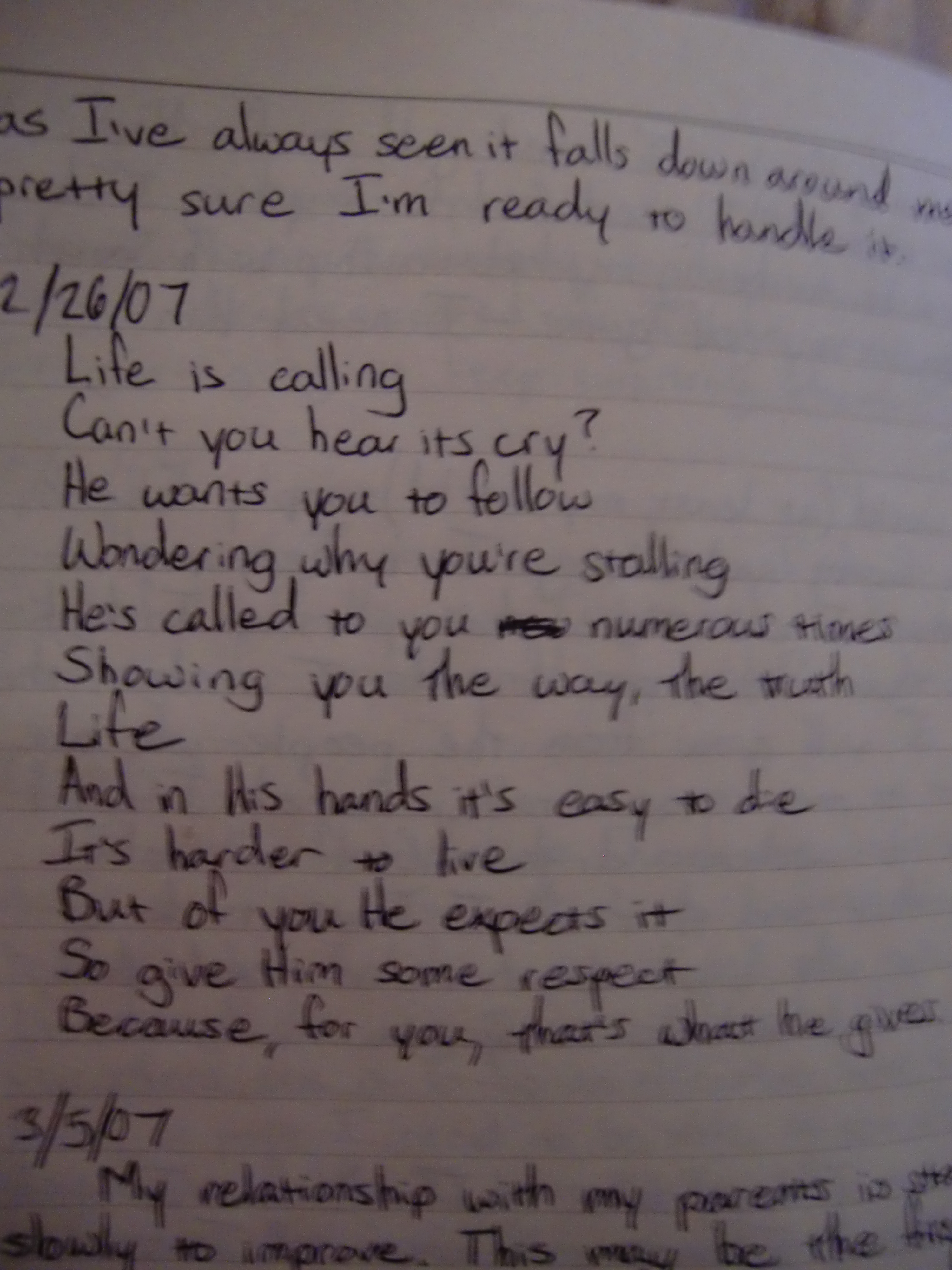
Moody and Poetic Teenage Writing

Some moody and poetic teenage writing.

Over the years, writing and I have had a bit of a rocky relationship. He helped me get a girlfriend in high school. And then I didn’t talk to him for a while. But then he selflessly got me into college, and I started hanging out with him again. Then he made me into a hipster, and I couldn’t forgive him for a while. The thing is, though, that I’ve never really been fair to writing. I’ve been using him for ulterior motives even before I knew what that word meant.

One night, when writing and I were on the outs, I went on a run because I was feeling kind of alone, and when you are feeling alone and you and writing are on the outs, there isn’t much else to do but to run. And while I was running, I was kind of talking to God because God is easy to talk to when there aren’t people around and the night is dark and you are in a golf course. While I was running and being with God, I realized that writing should be a little bit like talking to God. When you talk to God, it’s kind of hard to be selfish. Being selfish with God is a bit like meeting the president and asking him why they served cold food at your school that morning. It’s just not something you do. Instead, when you are talking to God, you start to realize all of the things you care about and all the people you care about. That’s a really beautiful thing, and it dawned on me that night while running and talking to God, that writing should be beautiful in that way.

So I’m making a commitment. Writing should be like talking to God.

The title of this site is “Spencer Writes,” but it’s only that because it’s cute and catchy. What I really want it to say is “Spencer Writes About People He Loves” because there really isn’t anything else worth writing about.