Now, we believe that the majority of teachers in America know our system must be reformed, to put students first so that
America can compete, that teachers don’t teach to become rich or famous. They teach because they love children. – Chris Christie
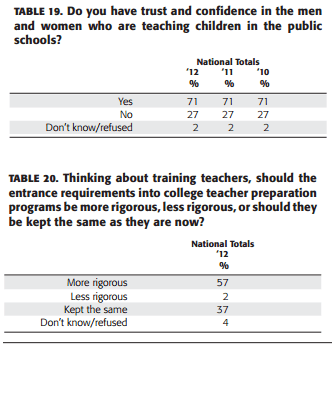 New Jersey Governor Chris Christie stated his belief in the good-will of teachers on August 28 at the Republican National Convention. It’s not a hard stand to take. According to the latest Phi Delta Kappa/Gallup poll, Americans almost universally support teachers. About three fourths of Americans say they have confidence in K-12 teachers. Compare this with the way Americans would grade schools and the difference is striking – over three fourths say they would give the US public education system a C or lower. Governor Christie, then, is by no means stretching himself when he supports teachers. Most people hold teachers fondly. Most of us had a couple dozen of them before we graduated high school, and we associate the majority of them with helping us navigate our formative years.
It’s confusing, then, when leading critics against the education reform movement, like Diane Ravitch, say there is a “war on teachers.”
What war on teachers?
I have never met a person who universally hates teachers. In fact, basically everyone I know in education, education reform, and education policy absolutely adores teachers.
But Diane Ravitch is not alone in the war on teachers claim. Teacher unions claim it, too.
On Tuesday night, Randi Weingarten, president of the American Federation of Teachers Union, tweeted about Gov. Christie’s remarks.

The remarks Weingarten probably takes issue with are these:
They believe the educational savages will only put themselves ahead of children, that self- interest will always trump common sense, they believe in pitting unions against teachers, educators against parents, lobbyists against children. They believe in teachers’ unions. We believe in teachers. – Gov. Christie
But this is not an attack on teacher’s’ unions. It’s an attack on Democrats (which, quite frankly, is to be expected at the Republican National Convention). This is a sentiment with which unions should agree. Unions should not be set up to perpetuate themselves but to support teachers.
This, then, is where the divide begins.
For the teachers’ union, the interest of the union is the interest of teachers is the interest of children. The problem with this line of thinking, of course, is that these three interests are not the same. They are definitely related and often overlap, but they are not the same. Critics of ed reform, however, believe that they are the same. One need look no further than Diane Ravitch’s interview with Randi Kaye on CNN.
In the interview, Kaye asks Ravitch about merit pay. Ravitch answers matter-of-factly that “teachers don’t want merit pay.” Kaye challenges this idea by showing Ravitch a comment from an inner-city teacher that says merit pay is not a war on teachers.
Ravitch, of course, is making the mistake I outlined above. The interest of the union is not necessarily in the interest of every teacher. That’s not how unions work. Most everyone who supports merit pay supports it precisely because it is a way to reward the teachers they hold most dear. No one supports merit pay in a sinister attempt to divide teachers. There is no war on teachers.
It’s important to note that there are thinly veiled attempts at union busting that are lauded as ed reform. Ohio faced this issue with SB5 a year ago. The bill would have outlawed collective bargaining. This bill did not have children at interest. It had the state’s budget at interest.
With all of that being said, it’s surprising to see Weingarten express distaste for Gov. Christie. Just a couple of weeks ago, Gov. Christie signed a law into effect that makes it harder for teachers in New Jersey to gain tenure. Teachers’ unions helped shape the law, and it was met with bipartisan support. This is the kind of compromise we should be working for.
But we can’t hope to promote this type of compromise when we are demonizing sides. Saying there is a “war on teachers” implies that the supporters of teacher tenure laws are enemies of teachers. This is damaging rhetoric. If teachers’ unions feel like they aren’t being respected, they should speak up and say so, but they also need to respect that the ed reform movement loves students and loves teachers.
War metaphors, in general, are lazy. So let’s try a little harder.


 Spencer J Smith